
Chapter 4 Exercise 1: Find two to three research papers, and illustrate the setup of the study. Ask a lab mate or classmate to do the same with the same study. Do your images look similar? Why or why not? (If the setups used in the research studies are clearly spelled out, your images will likely be similar to each other’s.)
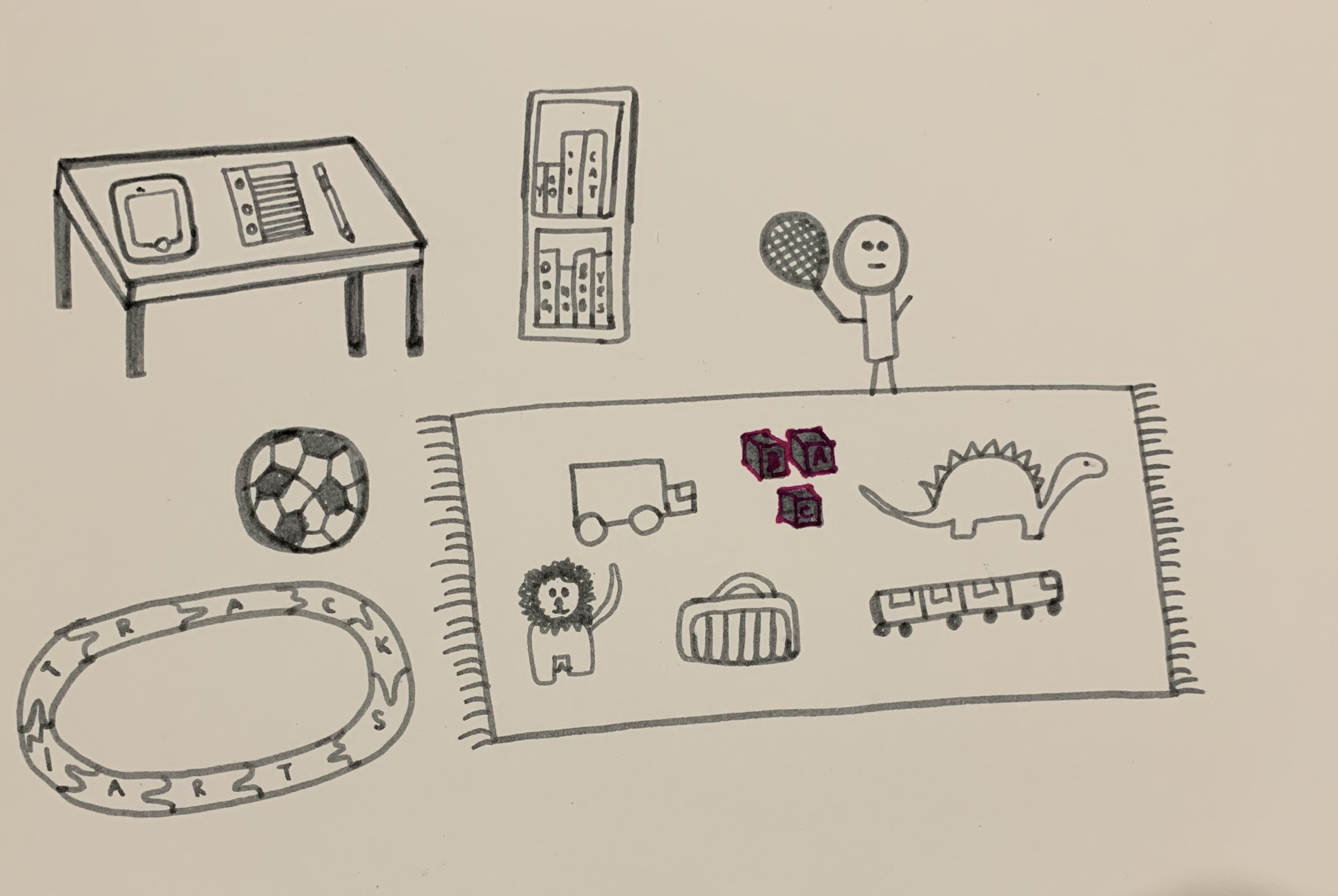
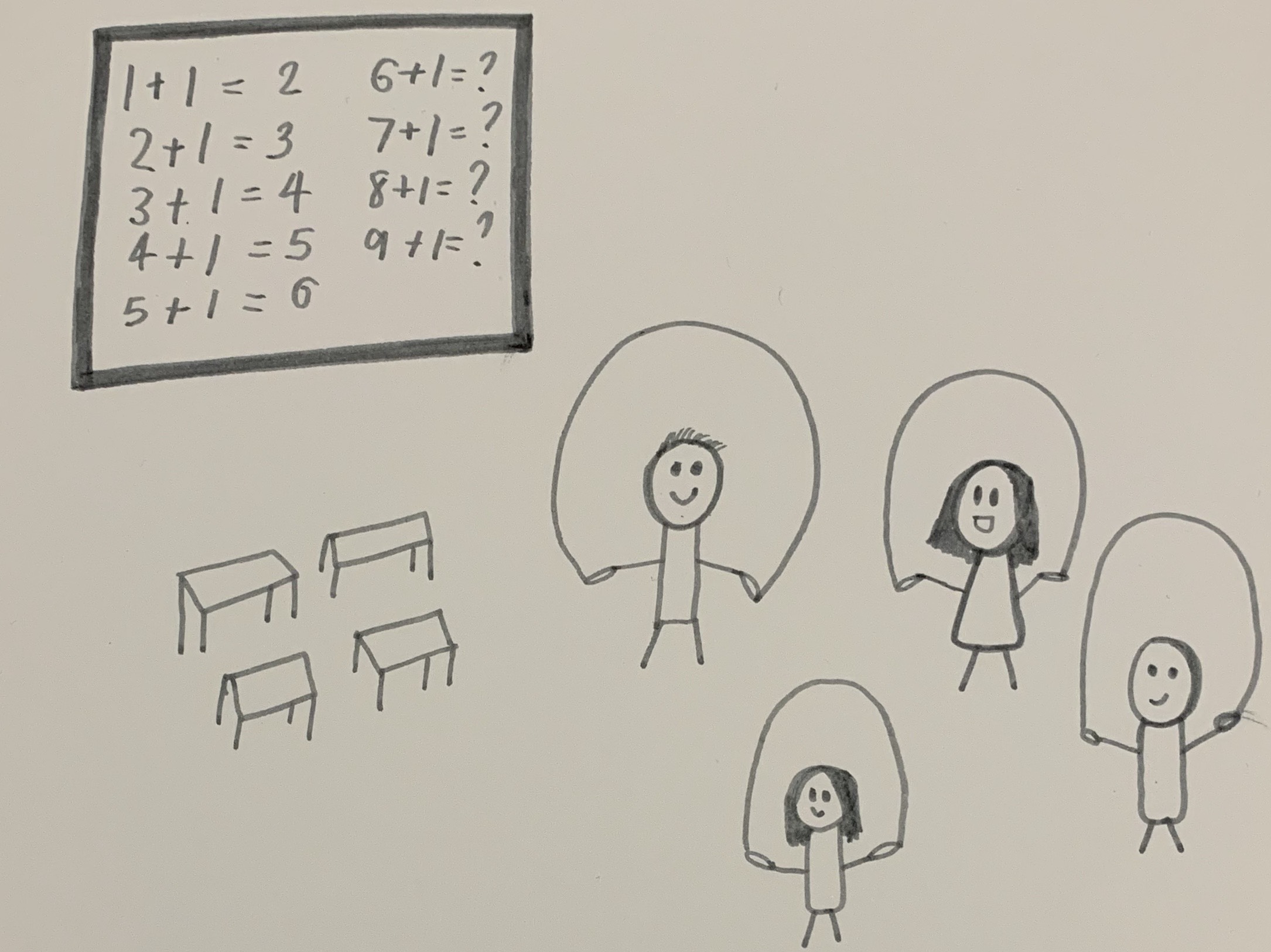
- I think the reason our images do not look similar is because most of the directions are very vague. In the study with autistic children, one of the steps is to have 35 objects. They do not specify the kinds of objects you will need. While this allows for variation, it may have different results every time.
Chapter 4 Exercise 2: The Internet (through such websites as YouTube, Pinterest, etc.) pro- videos you the opportunity to get a “feel” for research. Many journals and laboratories also have videos available online. Here’s a link from one of my classes: http://pinterest.com/triciastriano/professor-tricia-striano. Watching videos from other laboratories is one way to become familiar with various research paradigms and techniques. You may also get ideas about everything from how to position or hold a baby during a study to what sorts of stimuli other labs use in research studies. Find 10 videos. List the sources here. Share your observations with the class or laboratory, or perhaps even add them to your own social media site. Did watching these videos inspire any research questions? What are they?
- Emotional Starvation in Infants and its consequences. 1948 psychoanalytic research study
- Emotional Deprivation in Infancy :: Study by Rene A. Spitz 1952
- Infancy Studies Laboratory at Rutgers
- Facial Perception in Infants and Children
- Johns Hopkins University Researchers: Babies Learn from Surprises
- Still Face Experiment: Dr. Edward Tronick
- Notre Dame Infant Studies Lab
- Tuning In to Speech Sounds
- What Babies Teach Us About Perception
- Infant Studies: Improvements For The Future Of Infant Studies with Karen Adolph
- These videos show how we have improved research for infants and children. Early studies show that they would deprive infants from their mother. Now, every video explains how the parent will always be in the room with their child. In those studies, the babies all seemed to be in distress. This makes me think about the morality people might have. Though the findings might have helped improve research by showing that kids need their parent/mother. There are still so many things people would like to know about human behavior, but sometimes the way to get that information isn’t safe. This brings up a very important question: Should the outcome outweigh the means even if it is harmful?
Chapter 4 Exercise 3: Describe the scenes/setups shown in Figures 4.1 and 4.2. Copy your descriptions and give them to someone without showing him or her the images. Can he or she draw the setups based on your descriptions? This exercise will help you better describe the setups in your own research paper. Repeat this procedure with your own images.
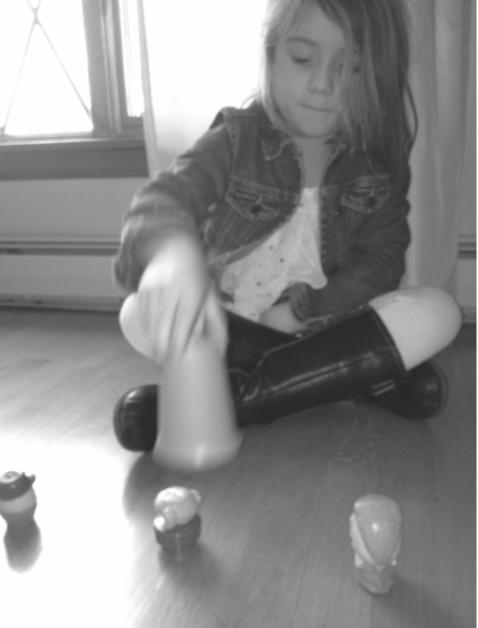
In Figure 4.1, a girl around the age of 5 is sitting on the floor playing with 3 different sized dolls and a cup. She is covering one with a cup.
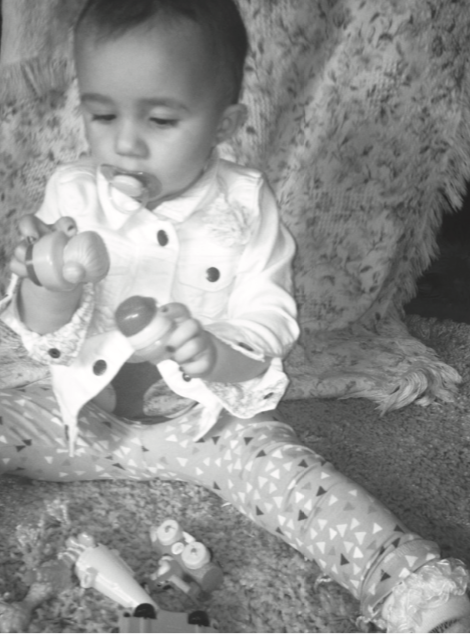
In Figure 4.2, an infant is sitting on a blanket playing with those same dolls adding a few more toys. The infant has two of those dolls in their hand.
- I think it’s difficult to describe the set up in general. Though there are very few items in the pictures, determining the focus or what the most important part of the study is. Though I had a difficult time explaining, the drawing was pretty similar. Though my description for Figure 4.2 was too vague when describing the toys the infant was playing with.
Chapter 4 Exercise 8: Make a list of relevant research-related talks and events in your community occurring this month. Do not forget to consider museums, theaters, clubs, and any other relevant venues.
- What: NYC Child Care Resource and Referral Consortium: Manhattan/Bronx
When: March 9th, 2019 10am-2pm
Where: Hunter College School of Social Work
Description: An informal professional development day to gather information and resources for your child care business with opportunities to attend short information sessions.
2) What: 2019 Young Child Expo and Conference NYC
When: Tuesday April 30th, 2019 7:30am-Friday May 3rd, 4:30pm
Where: 481 8th ave, New York, New York
Description: A unique forum that brings together all early childhood professional such as
Teachers, psychologists, special education teachers, social workers, physical occupational and speech therapists, pediatricians, nurses, and educators.
3) What: Open house for Bright Horizons
When: April 10th, 4:30pm-6:00pm
Location: Bright Horizons at 345 Adams Street
Description: Day Care Center
Chapter 5 Exercise 1: What’s the big question that you are addressing? This is an overarching general question that will drive your research and the decisions that you make along the way.
My big question is: What is the impact of fine motor skills in child development?
What’s the specific question that you are addressing?
Write your specific research question on the lines below. (Note that I have not left too much room for your answer. This is because your question should be written in a concise way!)
My specific question is: Does a child’s use of LEGO’s impact STEM capabilities later on in life?
What literature did you read to inspire this question? Here, cite 10–20 articles in APA format, and summarize each article. (There is space here for 10 articles. Use your research lab log if you need more space for additional articles.)
Summary: Duncan et al. (2007) presented a new methodology for identifying kindergarten readiness factors and quantifying their importance by determining which of children’s developing skills measured around kindergarten entrance would predict later reading and math achievement.
Summary: The aim of this study was to determine whether information obtained from measures of motor performance taken from birth to 4 years of age predicted motor and cognitive performance of children once they reached school age.
Summary: This study examined the contribution of executive function (EF) and multiple aspects of fine motor skills to achievement on 6 standardized assessments in a sample of middle‐socioeconomic status kindergarteners.
Summary: They reviewed the status of knowledge, in preterm children, on the development of fine motor skills, the relation with gross motor skills, and risk factors for impaired fine motor skills.
Summary: The aim of the current study was to determine how motor performance in infancy and early childhood is related to levels of anxious and depressive symptomatology at age 6–12 years.
Summary: A repeated-measures, waiting list control design was used to assess efficacy of a social skills intervention for autistic spectrum children focused on individual and group LEGO© play.
Summary: We utilized a parent-administered children’s fine and gross motor activities questionnaire (MAQ) to investigate links with FMS.
Article #8: Zhang, L., Sun, J., Richards, B., Davidson, K., & Rao, N. (2018). Motor Skills and Executive Function Contribute to Early Achievement in East Asia and the Pacific. Early Education and Development, 29(8), 1061-1080.
Summary: This study examined the contributions of motor skills and executive function (EF) to early achievement.
Summary: Simulations, role-playing scenarios, and other forms of active learning are meant to enhance the learning process by providing alternate methods to convey knowledge to students.
Summary: The aims of this study were to investigate fine motor skills of children with both attention-deficit–hyperactivity disorder (ADHD) and developmental coordination disorder (DCD).
Chapter 5 Exercise 3: Find six research journals. What is the scope of each journal (as defined in its website and the journal’s pages)?
List links to journals here.
Scope: This work-in progress presentation depicts the use of a Lego robotics kit and RoboLab software to meet the science, math and technology standards of local elementary school
Scope: The purpose of this study was to examine the effects of a peer-mediated LEGO® play intervention on improving social skills for children with ASD in an inclusive preschool in China
Scope: The purpose of this study was to determine whether low-cost robots provide a means by which children with severe disabilities can demonstrate understanding of cognitive concepts.
Scope: Sex differences in spatial ability have been argued to originate from sex differences in children’s play preferences. Child (30 boys and 20 girls) were asked to construct a specific three-dimensional model using Lego blocks and were also given the Shepard and Metzler test of mental rotation.
Scope: The research question asked was “Will those children ages three and four who have intensive play experiences in play‐based preschools and who can perform at high levels of LEGO building as constructional play also show high levels of mathematical achievement later in formal school settings?”.
Scope: They investigated correspondence between verbal and nonverbal behavior in preschool children in a play setting. They used legos in their method.
Copy one journal’s statement of its “scope” here.
Scope: The research question asked was “Will those children ages three and four who have intensive play experiences in play‐based preschools and who can perform at high levels of LEGO building as constructional play also show high levels of mathematical achievement later in formal school settings?”.
Imagine that you are submitting a research paper to the journal. What is the title of your paper as a function of each journal’s scope, as defined above? Provide six titles for the same research paper. Do these titles reflect the question? Why is the question important, and what is new in your study?
Journal #1 Title: Using a LegoRoboKit to meet STEM requirements.
Journal #2: Effects of Lego play on social skills
Journal #3: Lego Robots and their significance to Cognitive Abilities
Journal #4: Spatial Ability in play with lego’s
Journal #5: Lego play now, Cognitive Achievement Later
Journal #6: Will Lego Building have an effect on mathematical achievement?
These titles reflect the question, Does a child’s use of LEGO’s impact STEM capabilities later on in life? The question is important to see if there is a correlation between active lego use and academic achievements.
Chapter 5 Exercise 4: Read the submission guidelines of three journals. Which journal(s) would you select for your paper?
- APA: Li, Y., Huang, Z., Jiang, M., & Chang, T.-W. (2016). The effect on pupils’ science performance and problem-solving ability through Lego: An engineering design-based modeling approach. Journal of Educational Technology & Society, 19(3), 143–156. http://proxy.wexler.hunter.cuny.edu/login?url=http://search.ebscohost.com/login.aspx?direct=true&db=psyh&AN=2016-35586-004&site=ehost-live
- APA: Coxon, S. V. (2012). The malleability of spatial ability under treatment of a FIRST LEGO league-based robotics unit (Order No. 3492309). Available from ProQuest Dissertations & Theses A&I. (916772349). Retrieved from https://search.proquest.com/docview/916772349?accountid=27495 https://search.proquest.com/docview/916772349
- Gura, M. (2012). Lego Robotics: STEM Sport of the Mind. Learning & Leading with Technology, 40(1), 12-16.
https://files.eric.ed.gov/fulltext/EJ991224.pdf
Write an abstract for a possible research study. How does the abstract change as a function of each journal’s scope and submission guidelines?
- Previous research suggests a positive correlation between use of legos as a minor and STEM literacy. Science, technology, engineering, and math are demanding subjects that are typically viewed as more difficult fields of study. The purpose of this research study is to find a distinguishable connection between lego usage and STEM literacy, in order to provide adequate suggestions for advantageous childhood toys. Using data from previous research studies, we compared and sought patterns amongst STEM literacy and legos. Ultimately we found significant results amongst a variety of studies, suggesting STEM literacy is heavily influenced by use of legos as a minor. Future studies may be advantageous in order to provide children with toys that will enhance their STEM capabilities.
- Each journal’s scope and submission guidelines were very specific to a step-by-step study. A controlled study took place with clear methods provided. My abstract differs by combining multiple studies, rather than conducting my own.
Chapter 6 Exercise 1: Read “From New Logos to New Coke: 5 Corporate Mistakes” (http:// msn.com/en-us/money/companies/from-new-logos-to-new-coke-5-corporate- mistakes/ar-AAa524k#page-1) and “15 Worst Corporate Logo Fails” (www. businessinsider.com/15-worst-corporate-logo-fails-2012-1?op=1). As you are thinking about the design of your logo, you might also like to watch the film Helvetics (http://www.helveticafilm.com). Helvetica is a feature-length independent film about typography, graphic design, and global visual culture. It looks at the proliferation of one typeface (which celebrated its 50th birthday in 2007) as part of a larger conversation about the way type affects our lives. The film is an exploration of urban spaces in major cities and the type that inhabits them, and a fluid discussion with renowned designers about their work, the creative process, and the choices and aesthetics behind their use of type (http://www.helveticafilm.com/about.html).
Another relevant film is Art & Copy (available on DVD). “ART & COPY is a powerful new film about advertising and inspiration. Directed by Doug Pray (SURFWISE, SCRATCH, HYPE!), it reveals the work and wisdom of some of the most influential advertising creatives of our time—people who’ve profoundly impacted our culture, yet are virtually unknown outside their industry. Exploding forth from advertising’s ‘creative revolution’ of the 1960s, these artists and writers all brought a surprisingly rebellious spirit to their work in a business more often associated with mediocrity or manipulation: George Lois, Mary Wells, Dan Wieden, Lee Clow, Hal Riney, and others featured in ART & COPY were responsible for ‘Just Do It,’ ‘I Love NY,’ ‘Where’s the Beef?,’ ‘Got Milk,’ ‘Think Different,’ and brilliant campaigns for everything from cars to presidents. They managed to grab the attention of millions and truly move them. Visually interwoven with their stories, TV satellites are launched, billboards are erected, and the social and cultural impact of their ads are brought to light in this dynamic exploration of art, commerce, and human emotion” (http://www.artandcopyfilm.com/synopsis).
For more on graphic design tips that may help you with recruiting for your study, read 100 Ideas that Changed Graphic Design, by Steven Heller and Véronique Vienne (published in 2012 by Laurence King Publishing Ltd.).

You have just started your own laboratory that studies cognitive development among 3- to 7-year-olds. Design your logo here.
You have just started your own laboratory that studies stress among college-age students taking research methods classes. Design your logo here.

Show your logo to five people. What are their comments?
My friends explained that it doesn’t give off the impression that you’re dealing with mental health issues because it’s in the shape of a heart. They suggested I focus on using a brain as the main design.
Can you improve your logo based on their comments? Why or why not? If so, design another one or two on the next page.

They stated this is much clearer because it used the metaphor of a computer chip as the brain, suggesting rewiring of the brain to eradicate stress and mental health issues is possible and something our facility aims to do.
Chapter 6 Exercise 6: Find three ads for research studies on the web. List the links here.
What are the pros and cons of each?
Would you participate in the studies? Why or why not?
- Brain Imaging Study of Anxiety in Adolescents
Pros: Study takes place in NYC, convenient location; Pay is $170.
Cons: Study takes two days to complete and cannot be completed in one session. - Coping with Stress
Pros: Study takes place in NYC, convenient location; Pay is $100.
Cons: The test is studying stress reactions, therefore you may be exposed to mentally stressful situations. The study does not provide treatment in the event the experiment upsets the subject. - Smartphone Assessment of Mood
Pro: Study takes place in NYC, convenient location; Pay is $625.
Cons: Study requires access to your phone for months at a time, which eradicates your privacy.
- I would not participate in any of these studies. They each seem too intrusive for me. The first study requires too much time, the second study is a stressful experience, and the third study seems like an invasion of privacy.


